



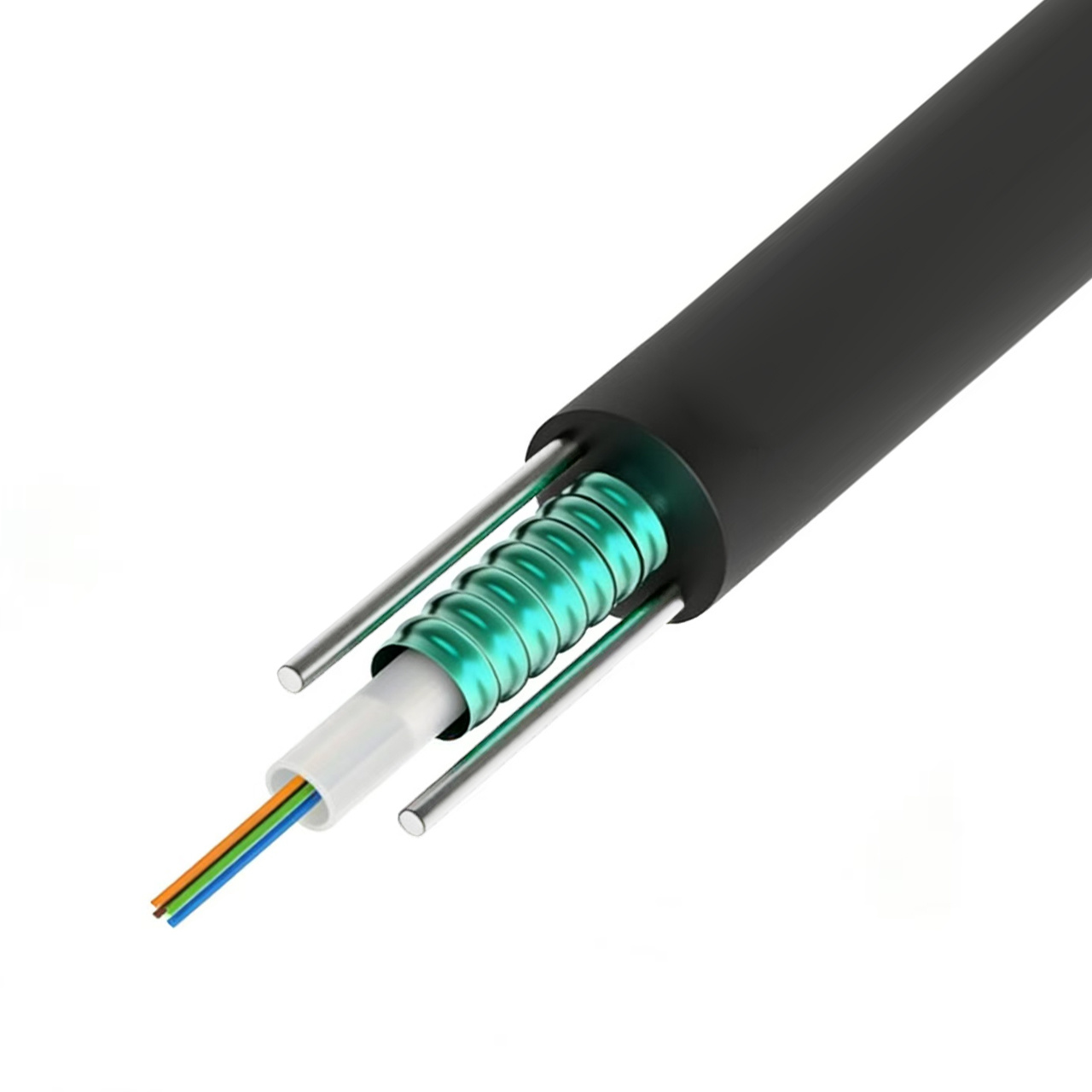
GYXTW Duct Armored Fiber Optic Cable
GYXTW Duct Armored Fiber Optic Cable
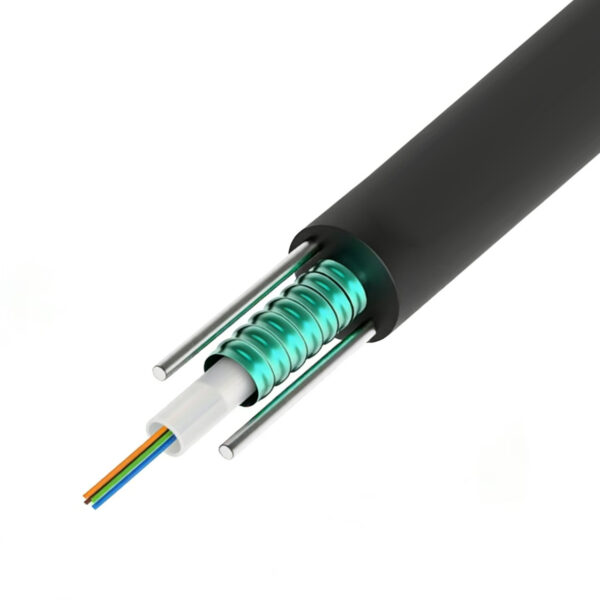
GYXTW is an outdoor fiber optic cable designed for duct/conduit installation and commonly used in access and distribution networks. It uses a central (uni) loose tube filled with water-resistant compound, combined with a longitudinal steel tape layer (PSP) and two parallel steel wires to provide mechanical protection and pulling strength, finished with a UV-resistant PE/HDPE outer sheath. Typical fiber count range: 2–24 cores (other counts may be available by design).
Product Overview
GYXTW is an outdoor fiber optic cable designed for duct/conduit installation and commonly used in access and distribution networks. It uses a central (uni) loose tube filled with water-resistant compound, combined with a longitudinal steel tape layer (PSP) and two parallel steel wires to provide mechanical protection and pulling strength, finished with a UV-resistant PE/HDPE outer sheath.
Typical fiber count range: 2–24 cores (other counts may be available by design).
Applications
Outdoor duct / conduit routes (metro/access rings, feeder/distribution)
Aerial (lashed) installation when permitted by project design
Campus networks, ISP builds, CCTV backhaul, industrial communication links (project-dependent)
Cable Construction
Typical structure (from center outward):
1.Optical fibers (250 μm) placed in a PBT central loose tube, tube filled with water-resistant compound
2.Water-blocking layer (e.g., water-blocking tape/material) applied to maintain compactness and longitudinal water blocking
3.PSP steel tape applied longitudinally around the tube (steel tape moisture/impact/crush protection)
4.Two parallel steel wires placed on both sides as strength members
5.Outer sheath: black PE/HDPE, UV-resistant for outdoor use
Fiber Options
Common options depend on project requirement:
Single-mode: ITU-T G.652.D (typical)
Multimode: 50/125 μm, 62.5/125 μm (optional by order)
Fiber Color Identification
Typical 12-fiber color sequence:
Blue, Orange, Green, Brown, Gray, White, Red, Black, Yellow, Violet, Pink, Aqua
Mechanical & Environmental Performance (Typical)
1.Bending Radius:
Static (no tension): ≥ 10 × cable OD
Dynamic (under tension): ≥ 20 × cable OD
2.Tensile / Crush (Common grades):
Different suppliers provide two common mechanical “grades” depending on sheath thickness and design:
Grade A (standard): Tensile 600/1500 N (long/short)
Grade B (reinforced option): Tensile 1000/3000 N (long/short)
Crush resistance is commonly specified as either:
300/1000 N/100 mm (long/short) in some specifications
1000/3000 N/100 mm (long/short) for reinforced designs
3.Temperature Range (Typical):
Operation: -40 °C to +70 °C
Storage/transport: -40 °C to +70 °C
Installation: commonly -10 °C to +70 °C (varies by spec)
Optical Characteristics (Single-Mode G.652.D — Typical Limits)
1.Attenuation coefficient (max):
1310 nm: ≤ 0.36 dB/km
1383 nm: ≤ 0.32 dB/km
1550 nm: ≤ 0.22 dB/km
1625 nm: ≤ 0.30 dB/km
2.Chromatic dispersion (max):
1550 nm: ≤ 18 ps/(nm·km)
1625 nm: ≤ 22 ps/(nm·km)
Cable cut-off wavelength: ≤ 1260 nm
Standards & Test References
Many GYXTW specifications reference IEC 60794-series test methods and related requirements; some suppliers also cite IEEE 1222 for outdoor cable design requirements.
Typical mechanical/environmental tests include:
Tensile test: IEC 60794-1-2-E1 (loss change and no damage criteria)
Crush test: IEC 60794-1-2-E3
Impact test: IEC 60794-1-2-E4
Temperature cycling: commonly per YD/T series in some specs
Sheath Marking & Length Marking
Sequential length marking is typically printed at ~1 m intervals, with length accuracy commonly controlled within ±1%, and marking content including manufacturer name, cable type, production date, and meter marking.
Packaging, Storage, Handling
Standard supply is on wooden drums; drum length options vary by design and logistics.
Store drums upright in a dry area; keep ends sealed until installation.
During installation, control pulling tension and maintain the specified bending radius.