
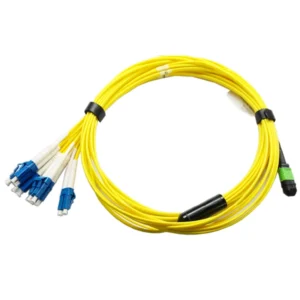



For years, the global optical fiber industry was trapped in fierce price competition. Manufacturers faced thin margins, buyers enjoyed low prices, and supply was rarely a concern. In 2026, that situation changed dramatically. Across the market, single-mode fiber prices are rising at a pace not seen in nearly a decade, with G.657.A2 bend-insensitive fiber becoming one of the most in-demand products in the industry.
According to multiple industry reports, prices for some G.657.A2 fibers have increased several times compared with 2025 levels, while lead times continue to extend as manufacturers struggle to keep up with demand.
The biggest driver behind the price surge is the explosive expansion of AI infrastructure. Large-scale AI data centers require significantly more fiber connectivity than traditional cloud facilities. High-density GPU clusters depend on ultra-fast optical transmission between servers, switches, and storage systems. Industry analysts estimate that AI-focused data centers may consume five to ten times more optical fiber than conventional facilities.
At the same time, telecom operators around the world are continuing broadband upgrades, 5G expansion, and backbone network construction. Demand from North America, Southeast Asia, the Middle East, and Latin America remains strong, pushing global fiber consumption to record levels. Chinese optical fiber manufacturers, which account for more than half of global production capacity, are seeing overseas orders increase rapidly in 2026.
Among all fiber types, G.657.A2 has become especially difficult to source. Unlike standard G.652.D single-mode fiber, G.657.A2 offers superior bend resistance, making it ideal for FTTH deployment, high-density data centers, indoor cabling, and compact routing environments. Its ability to maintain stable performance under tight bending conditions has made it increasingly popular in modern communication networks.
However, G.657.A2 is also more complex to manufacture. Production efficiency is lower, drawing speeds are slower, and quality requirements are stricter. As more manufacturers shift capacity toward high-end bend-insensitive fiber, supply for the broader market becomes tighter.
Another critical factor is the shortage of optical fiber preforms. Preforms are the core raw material used in fiber drawing, and expanding preform production is neither fast nor easy. Industry sources estimate that building new preform capacity can take 18 to 24 months, requiring heavy investment and advanced technical expertise.
This supply bottleneck means that even if manufacturers want to increase output immediately, the industry cannot respond quickly enough. As a result, many suppliers have already locked production schedules months in advance, while spot prices continue fluctuating upward.
Raw material inflation is adding further pressure throughout the supply chain. Rising costs for plastics, aramid yarn, packaging materials, and transportation have also increased the prices of downstream products such as fiber optic cables, patch cords, adapters, and distribution boxes.
For telecom contractors, ISPs, distributors, and data center operators, the current market environment presents new challenges. Long procurement cycles, unstable quotations, and limited inventory are becoming common across the industry. Buyers who previously relied on short-term purchasing strategies are now moving toward long-term supply agreements to secure stable deliveries.
Despite the current pressure, the long-term outlook for the optical communication industry remains highly positive. AI computing, cloud infrastructure, smart manufacturing, and next-generation broadband networks will continue driving global fiber demand over the coming years.
For manufacturers and suppliers, 2026 is becoming a turning point for the optical fiber market. What was once a highly competitive industry focused mainly on low prices is now shifting toward capacity security, supply stability, and high-performance fiber solutions.
As demand for G.657.A2 single-mode fiber continues growing worldwide, companies with stable production capability, strong inventory management, and reliable delivery systems will become increasingly valuable partners in the global optical communication supply chain.