
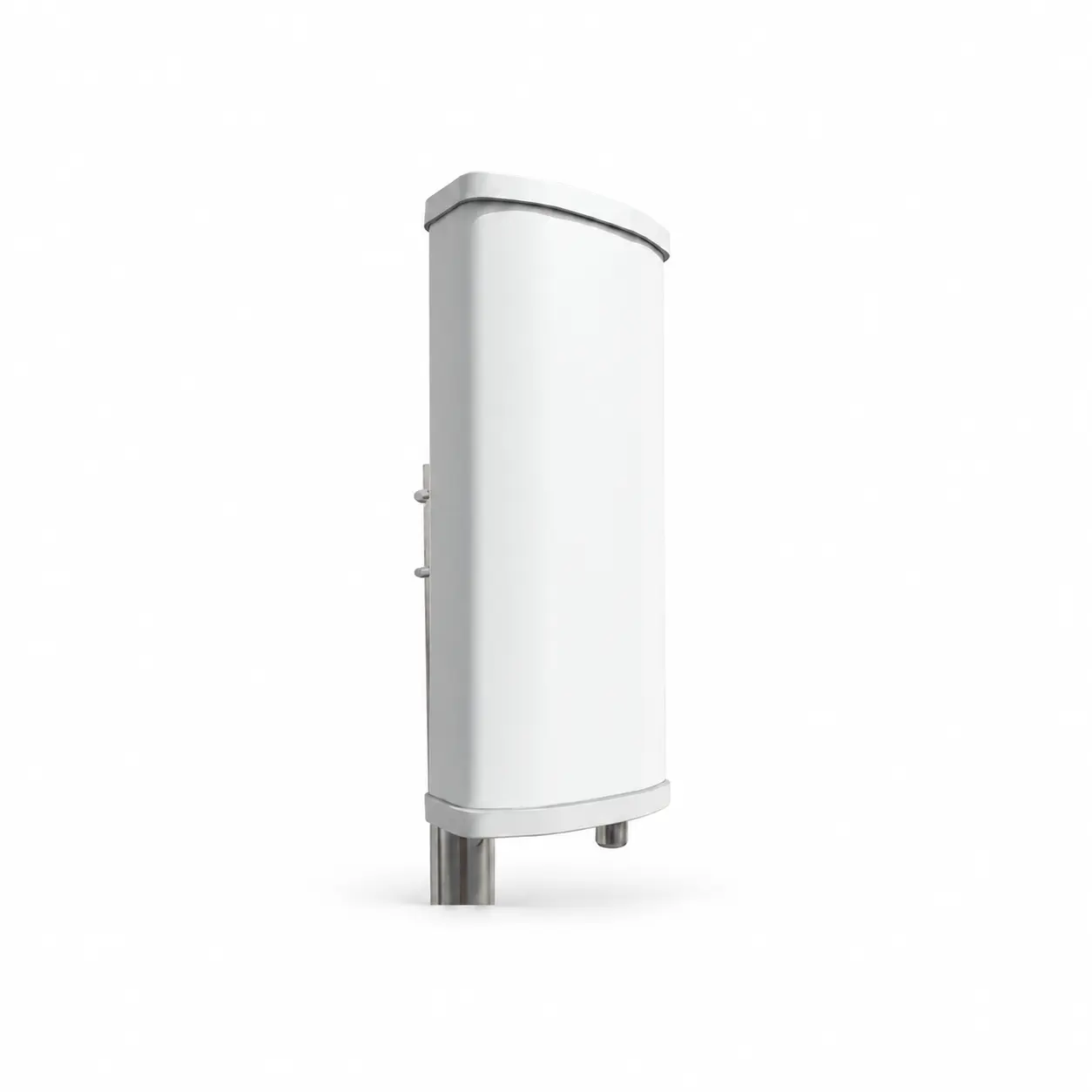
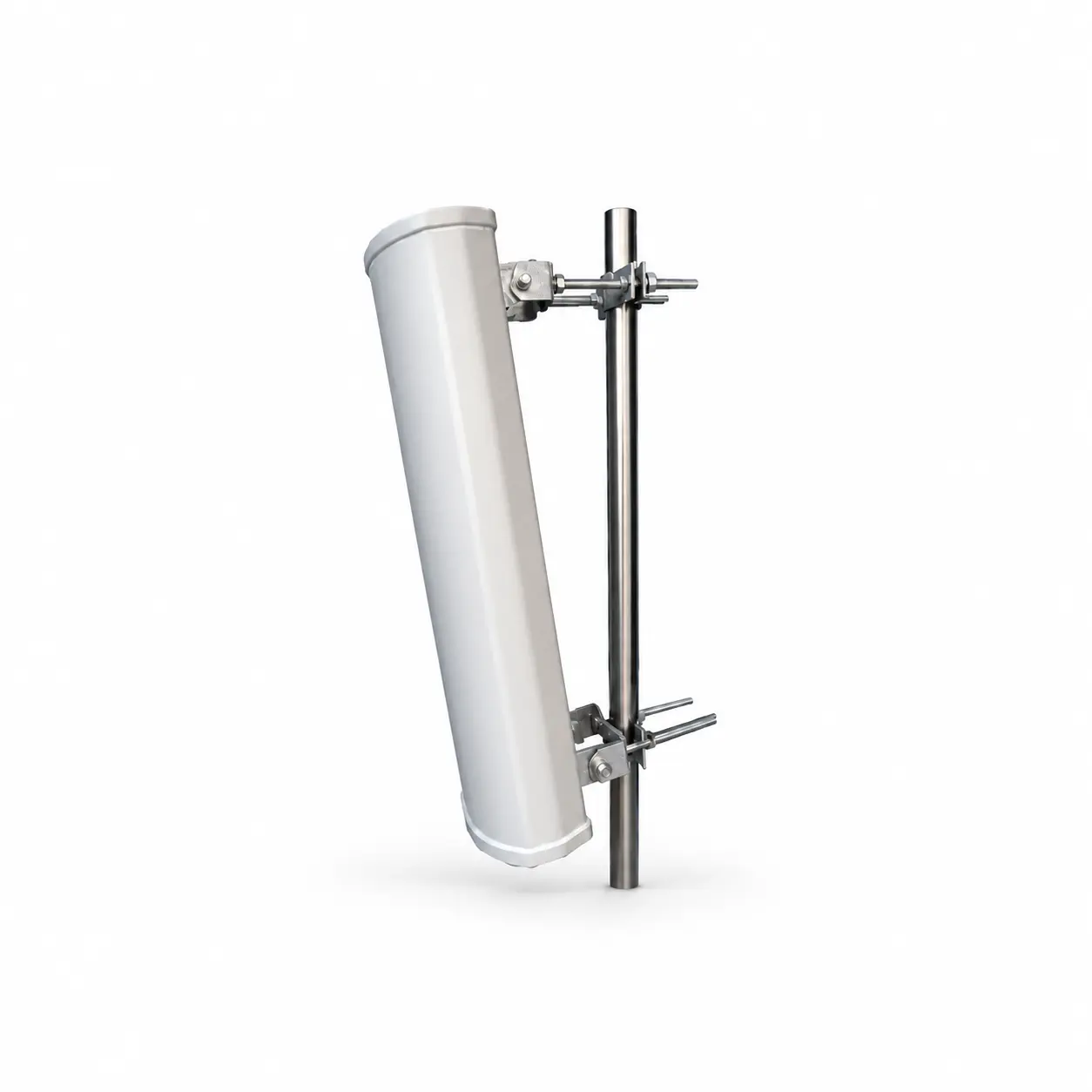
Frequency directly determines the transmission distance, wall penetration capability and power consumption of an antenna. It is the primary factor for antenna selection.
1. 5.8 GHz Band
- Frequency: 5150-5850 MHz
- Features: High frequency with short wavelength; weak penetration and diffraction; obvious signal attenuation caused by walls and trees.
- Applications: 5G-WiFi (WiFi5 / WiFi6) WLAN, high-definition cameras, short-range high-speed IoT terminals.
2. 5G Band
- Frequency: 3300-3800 MHz
- Features: Large bandwidth and high transmission rate; weak wall-penetration and diffraction for high-frequency signals.
- Applications: 5G gateways, industrial DTU, HD video backhaul, high-speed networking for outdoor IoT terminals.
3. 4G / LTE
- Frequency: 824-960 MHz; 1710-2700 MHz
- Features: Operator cellular network with wide coverage and medium transmission rate; moderate indoor penetration capability.
- Applications: Charging piles, shared devices, industrial remote data acquisition, wireless data transmission terminals.
4. NB-IoT (Narrow-Band Internet of Things)
- Frequency: 824-960 MHz, 1710-1880 MHz
- Features: Extremely low power consumption, deep sleep mode, strong signal penetration, low data rate; suitable for battery-powered devices.
- Applications: Smart water/gas meters, manhole cover monitoring, asset anti-theft, low-power sensors.
5. LoRa (Sub-1 GHz)
- Frequency: 410-510 MHz (China domestic), including 433 MHz, 470-510 MHz
- Features: Long wavelength, excellent diffraction and wall-penetration performance, long transmission distance, low data rate; private networking without SIM cards.
- Applications: Agricultural monitoring, plant-area sensors, field environmental collection, industrial wireless sensing.
6. GSM / GPRS (2G)
- Frequency: 850-915 MHz, 1710 1880 MHz
- Features: Legacy 2G cellular network with low speed; being phased out in many regions.
- Applications: Legacy equipment, simple alarm terminals (Not recommended for new projects).
7. 2.4 GHz (WiFi / Bluetooth / Zigbee)
- Frequency: 2400-2500 MHz
- Features: Global license-free ISM band; supports compact antenna design; moderate wall-penetration, short transmission range.
- Applications: Smart home, Bluetooth sensors, indoor wireless switches, onboard module internal antennas.
8. GNSS (GPS, Beidou)
- Frequency: GPS L1: 1575.42 MHz; Beidou B1: 1561 MHz
- Features: Satellite-signal receiving only; circularly-polarized antenna required; high requirement for clear sky view; metal shielding shall be avoided.
- Applications: Positioning service, vehicle-mounted devices, UAVs, smart manhole covers, asset positioning, location reporting for charging piles.
9. UWB Ultra-Wide Band
- Frequency: 3.1-10.6 GHz
- Features: Ultra-large bandwidth, high-precision ranging & positioning, strong anti-interference capability, short transmission distance.
- Applications: Indoor centimeter-level positioning, personnel & material positioning in warehouses.
10. RFID Full-Band Summary (Four mainstream bands)
10.1 LF Low-Frequency RFID
- Frequency: 125 KHz-134.2 KHz
- Features: Long wavelength, good penetration through metal and water; extremely short communication distance (1-5 cm).
- Applications: Animal ear tags, access-control key fobs, parking-lot cards, induction door locks.
10.2 HF High-Frequency RFID
- Frequency: 13.56 MHz
- Features: Reading distance 5-20 cm, low cost, mature technology.
- Applications: NFC mobile phone card reading, campus cards, public transport cards, membership access-control cards, file management.
10.3 UHF Ultra-High-Frequency RFID
- Frequency: 860-960 MHz, domestic standard 902~928 MHz (China)
- Features: Long reading distance (3-15 m); batch reading for multiple tags; line-of-sight propagation; signals susceptible to metal and liquid interference.
- Applications: Warehouse inventory, logistics & express delivery, fixed asset management, production-line traceability, warehouse gateway access control.
10.4 Microwave RFID
- Frequency: 2.45 GHz
- Features: Long reading distance, high data rate; relatively high cost.
- Applications: High-speed production lines, long-range identification for large parking lots.
Note: Most commercial RFID antennas work at 902-928 MHz.
Frequency Band Selection Summary Table
| Frequency Band | Frequency Range | Key Features | Typical Applications |
|---|---|---|---|
| 315/433M | 310‑320MHz, 423‑443MHz | Long distance, low data rate | Remote control, alarm devices |
| LoRa | 470‑510MHz | Long‑range, private self‑built network | Field environmental monitoring |
| NB‑IoT | 800‑960MHz / 1710‑1880MHz | Low‑power, operator cellular network | Water/gas meters, manhole‑cover monitoring |
| UHF‑RFID | 902‑928MHz | Long‑range tag identification | Warehouse & logistics inventory |
| 4G LTE | 700‑2700MHz | Wide coverage, medium‑speed transmission | Charging piles, DTU gateways |
| 2.4G | 2400‑2500MHz | Compact size, license‑free ISM band | Bluetooth, WiFi, smart home |
| GNSS Positioning | 1561MHz / 1575.42MHz | Satellite positioning, circularly‑polarized antenna | Vehicle‑mounted, asset positioning |
| 5.8G | 5150‑5850MHz | High speed, low interference, weak wall penetration | Wireless video transmission, high‑speed WiFi |
| 13.56M HF‑RFID | 13.56MHz | Short‑range card reading | NFC, access‑control one‑card system |